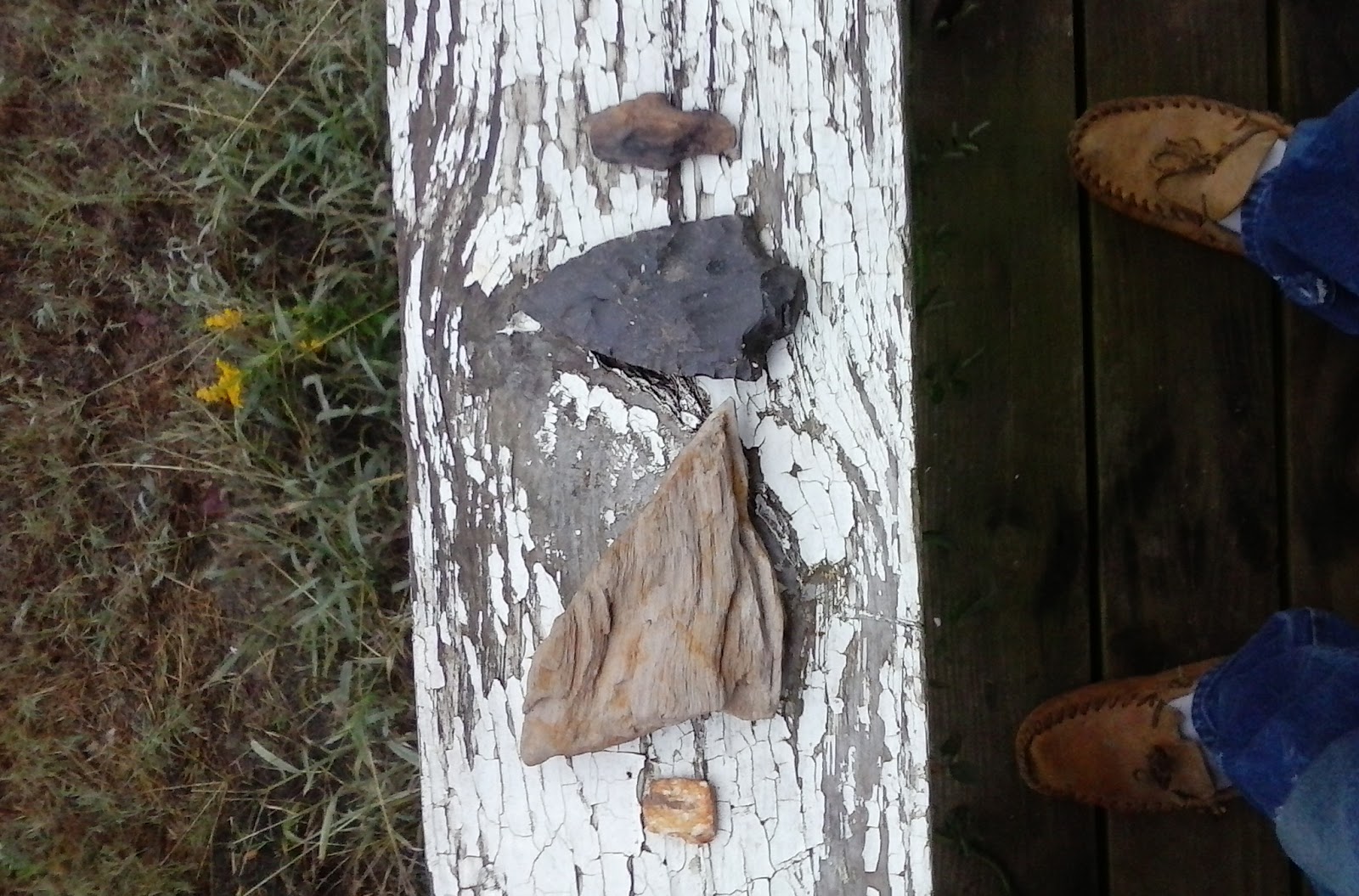
5,000-year-old artifacts found on Charlotte farm
CHARLOTTE – Brooke Ellsworth's grandfather used to tell stories about the little stone pieces of history unearthed on the family farm.
Her
great-grandfather Clyde Ellsworth would come in from a day of working
the land on his Spicerville Highway property with the occasional find in
hand — an arrowhead, stone pieces that looked like pendants, a hollow,
long piece of what looked like a peace pipe.
"He would till them up when he was farming out there," she said.
Over the years, those stone pieces were collected and tucked away.
It took Ellsworth just a few weeks after her grandmother's death in June to go through the keepsakes in her Springport home.
"She
was kind of a clean hoarder," she said. "She didn't like to throw
things away and she had so much stuff. There was still furniture from
the 50s in the attic."
The stone pieces had been scattered
throughout the house. Delicately carved arrowheads made of both light
and dark chert, all shapes and sizes. A broken, oblong, hollow piece of a
smoking pipe. Larger sharp, butterfly-shaped pieces of stone, probably
tools, and smooth flat rocks with small holes in the center that might
have adorned the necks of people alive thousands of years ago.
Late
last year, all 120 of them were rediscovered in a dusty, cluttered
attic — a collection that Ellsworth's grandmother Beverly hung on to for
decades. Once gathered together they fit in a moderately-sized
cardboard box.
It's a rare collection insofar as all of the pieces were pulled from the same 140 acres and kept together over the decades.
It's
also solid proof that the Ellsworth family wasn't the first to make
their home there. Groups of American Indians have inhabited that open
stretch of land between Charlotte and Eaton Rapids intermittently since
before the ancient Egyptians built the Pyramids at Giza.
A simple donation
Ellsworth and her father Chris made a decision.
The family would let the stones go, donate them to the Eaton Rapids Historical Society.
Deb
Malewski, the historical society's vice president, got her first look
at the artifacts in December. Within a day, she had convinced herself
that the stones were special.
"If all this came from one farm,
this is not your normal find," she said. "This isn't, somebody picks up
an arrowhead out in the farmer's field. This means something more than a
causal find. This is too much and in too good of shape to just have
been a random thing. This is a sign of some kind of settlement."
Enter
Stacy Tchorzynski, an archaeologist with the Michigan State Historical
Preservation Office and no stranger to significant finds.
"It's a great collection and we're only beginning to learn about it," said Tchorzynski.
The
items are in good shape. Spear points, arrowheads, pestles used to
grind spices and other items, banner stones used as weights on spears,
knives, a smoking pipe and pendants were found on the farm.
"People of all ages and genders would have used a tool kit like this," Tchorzynski said.
More importantly, she added, the collection was kept together, not scattered among relatives.
That
has allowed experts to date what's there. Some of the Ellsworth farm
artifacts date back 350 years. Some of them date back 5,000 years.
Farm's rich back story
Clyde Ellsworth bought the 140-acre farm in 1937. The land has stayed in the family since.
The flat, vast, snow-covered property was once home to cows, chickens, pigs and sheep and to acres of corn, wheat and hay.
Today,
one of Clyde's grandsons lives there in a one-story home. There are a
few barns too, off the rural, snow-drifted roadway, along with rows of
now-frozen corn stalks.
Most of the artifacts were found before
the family used massive, efficient machinery to work the land, back when
Clyde was still using horses to plow the fields. They popped up from
the freshly tilled earth in the animals' lumbering wake.
"As my grandfather followed the horses, he would pick up the arrowheads," Brooke Ellsworth said.
It's
easy to see why prehistoric people made their homes at site that is now
the Ellsworth farm. People chose settlements then for the same reason
they do today — location — and the farm was high ground between the
Grand and Kalamazoo rivers.
"It looks like people were living
there for several thousands of years on and off," said Tchorzynski.
"People kept coming back and back over the years there."
And even
something as inconsequential as trace amounts of burned food found
inside a ceramic pot can give scientists important information about how
they lived, said William Lovis, an anthropology professor at Michigan
State University and a curator at the MSU Museum.
"It can be
carbon dated," said Lovis. "Looking at the chemistry of the food can
tell us what plants and animals are there. You can tell generally what
they were cooking in the pot. That's all from a few milligrams of burned
on food."
American Indians living there 350 years ago during the
Late Woodland period likely would have made pottery and grown corn,
squash and beans, storing it to use later.
"These folks were actually very different from their ancestors," said Lovis. "They did not travel as much."
For
the earlier groups, whose use of the site goes back 5,000 years ago to
what's known as the Late Archaic period, it probably would have been
more a stopping place than a settlement.
They were nomads, living
in small groups, moving with the seasons and in search of food. They
hadn't begun making pottery yet and relied on hunting and gathering to
survive.
But when it comes what life was like for American Indians
that lived here long ago, experts don't actually know very much, Lovis
said.
Preserving, learning more
The
donation is a piece of the area's history, the 138th recorded
historical site in the county, one of roughly 22,000 in the state.
The
Eaton Rapids Historical Society wants to share and display it. A
program focused on the artifacts will be offered this summer. The group
will display the pieces at the historical Miller Farm.
"We really
have something cool here," said Malewski. "Other counties have thousands
of sites but very few are recorded here in Eaton County."
That may be because property owners aren't talking about what they find.
"People
have found stuff," said Malewski. "They just haven't reported it to the
state because they're afraid the state will take it away."
Which
can happen in certain cases but doesn't usually, according to Matthew
Fletcher, a Michigan State University law professor and the director of
the Indigenous Law & Policy Center.
"In general, private
property owners often can retain ownership over privately acquired
Indian artifacts and materials," said Fletcher. "However, if the
artifacts include eagle feathers or any eagle parts, and the owner is
not a member of a federally recognized tribe, then the ownership is
illegal under federal law."
Tchorzynski said her office does want
to document finds and offer land owners help in preserving and keeping
their collections together. Both efforts are key to helping experts
learn more about the history of the places where they were found.
"Really
the value of these sites can't be measured," she said. "Each site is
its own unique story. These are things to treasure."
Ellsworth said her family had "no idea" the stones her great-grandfather found were valuable pieces of the area's history.
"I'm so glad that we decided to donate them," she said, "because we never would have known otherwise."
At a glance
The
Spicerville Highway farm has been designated by the Michigan State
Historical Preservation Office as the 138th recorded historical site in
Eaton County.
There are 22,000 recorded historical sites on land
in Michigan. Some were once American Indian settlements. Others were
pioneer homesteads or logging sites. Another 1,500 shipwrecks or
underwater sites are on record.
Spear
points, arrowheads, pestles used to grind spices and other items,
banner stones used as weights on spears, knives, a smoking pipe and
pendants were found on the farm.
The items have led experts to
believe that more than one group of prehistoric Native Americans lived
on the land. Some of the 120 artifacts date 350 years, while others date
as far as 5,000 years.
The farm was likely considered high ground between two viable water sources, the Grand and Kalamazoo rivers